NEW DELHI: With greenfield land parcels in metros such as Mumbai largely exhausted, brownfield and cluster-led redevelopment has emerged as the primary pathway for urban expansion, industry leaders and policymakers said at the ET Realty Real Estate Conclave 2026.
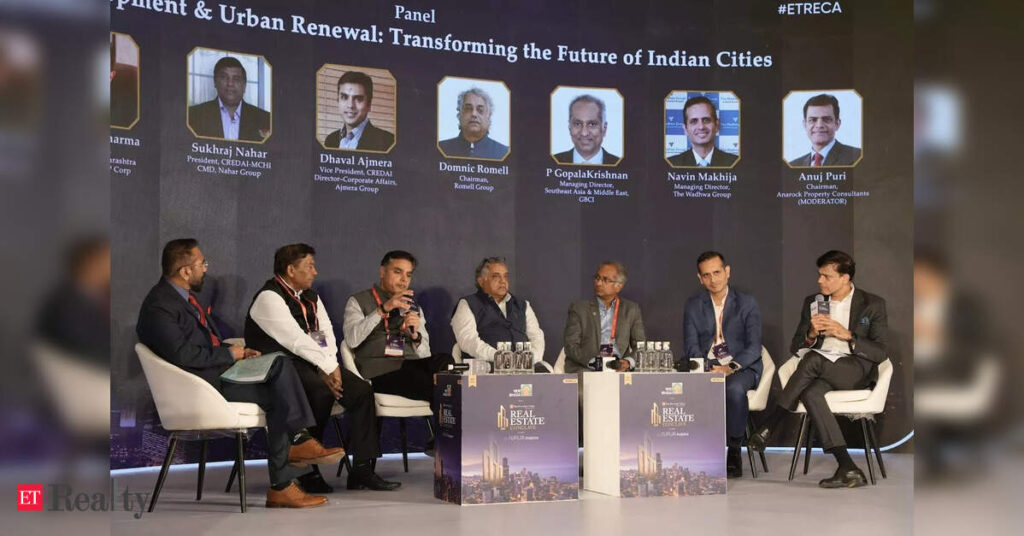
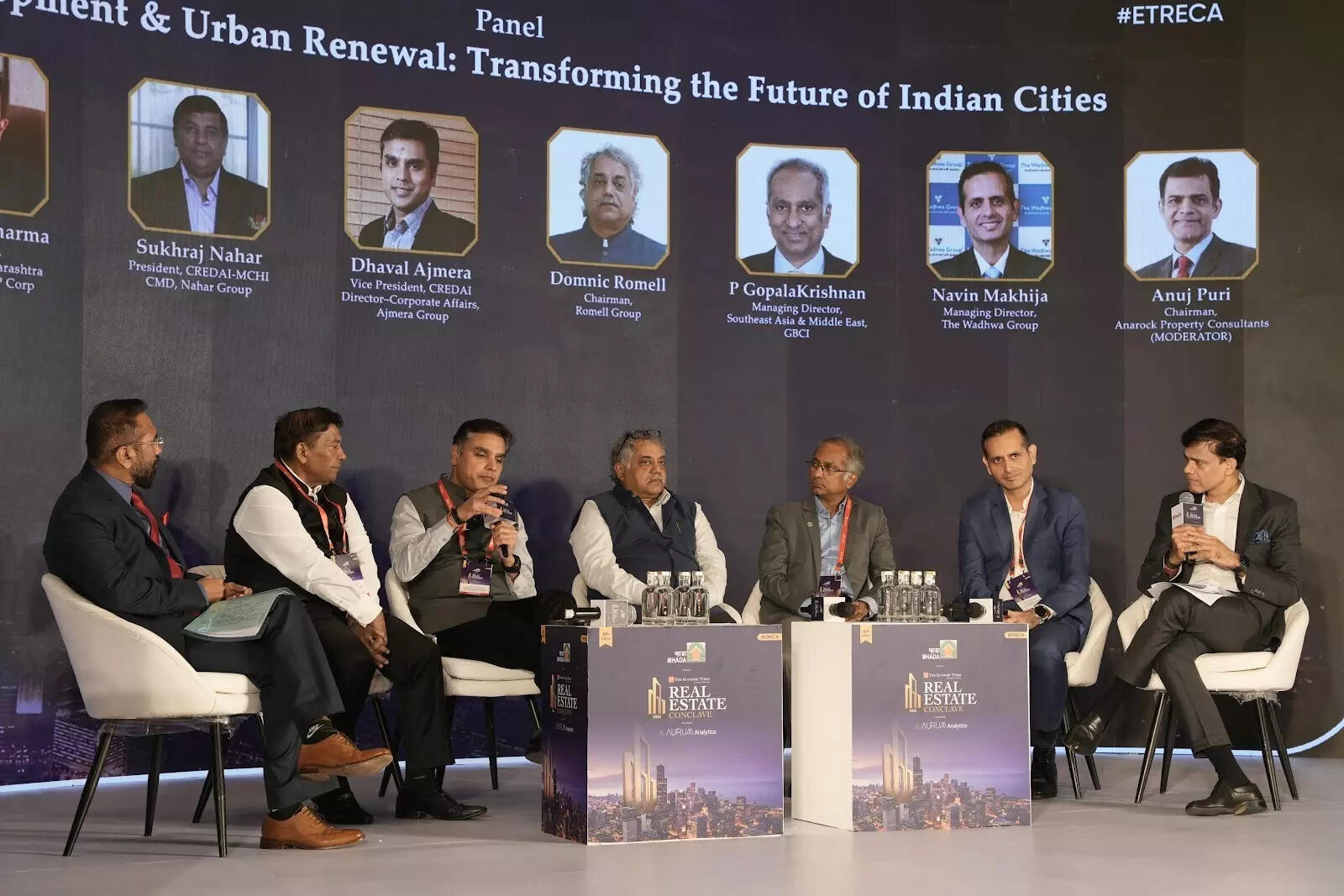
The panel discussion on ‘Redevelopment & Urban Renewal: Transforming the Future of Indian Cities’ was moderated by Anuj Puri, chairman, Anarock Property Consultants, and featured Anil Wankhede, deputy CEO, MHADA; Prashant Sharma, president, NAREDCO Maharashtra and chairman, GHP Corp; Sukhraj Nahar, president, CREDAI-MCHI and CMD, Nahar Group; Dhaval Ajmera, vice president, CREDAI and director–corporate affairs, Ajmera Group; Domnic Romell, chairman, Romell Group; P GopalaKrishnan, managing director, Southeast Asia & Middle East, GBCI; and Navin Makhija, managing director, The Wadhwa Group.
Opening the discussion, Wankhede said redevelopment must balance commercial viability with social inclusion. He noted that projects undertaken through MHADA generate housing stock for the authority, which is priced based on construction cost rather than market rates. Nearly 20,000 units are expected to be created through such mechanisms, helping supply subsidised homes alongside private redevelopment.
On funding dynamics, Prashant Sharma said institutional investors are increasingly evaluating large cluster-level projects, particularly those involving MHADA, SRA and society-led redevelopment. Among these, he noted that society redevelopment is often perceived as relatively lower risk due to clearer land ownership and planning visibility. However, investors remain cautious about smaller, stand-alone society projects due to execution complexity and fragmentation.
Sukhraj Nahar highlighted that beyond financial modelling, trust and governance are critical to successful redevelopment. Internal conflicts within housing societies and credibility gaps between stakeholders can derail projects. “Redevelopment is a marriage,” he said, underlining that while financial feasibility may drive a majority of decisions, long-term execution depends on alignment between societies and developers.
Dhaval Ajmera and Domnic Romell echoed the need for transparent communication, strong delivery track records and reputational credibility to mitigate risks in dense urban redevelopment.
Adding a sustainability perspective, P GopalaKrishnan said green compliance must move beyond procedural checklists to measurable outcomes. In high-density brownfield zones, he said, integrating energy efficiency, climate resilience and community-scale planning into cluster masterplans will be critical for long-term urban sustainability.
Navin Makhija stressed that redevelopment decisions cannot be driven solely by financial spreadsheets. Location fundamentals, product-market alignment and genuine end-user demand must underpin large-scale acquisitions. The panel broadly agreed that predictable regulations, faster approvals and structured financing models, including blended finance and rental housing mechanisms, will be essential to reduce project risk.
As Indian metros face land scarcity and ageing building stock, the consensus at the conclave was that cluster-led redevelopment, backed by governance discipline and sustainability integration, will define the next phase of urban transformation.