NEW DELHI: Jammu & Kashmir Real Estate Regulatory Authority (J&K RERA), which became operational only in January 2024, is focusing on structural reforms, master plan revisions and stricter enforcement of layout norms to formalise and expand the Union Territory’s real estate sector.
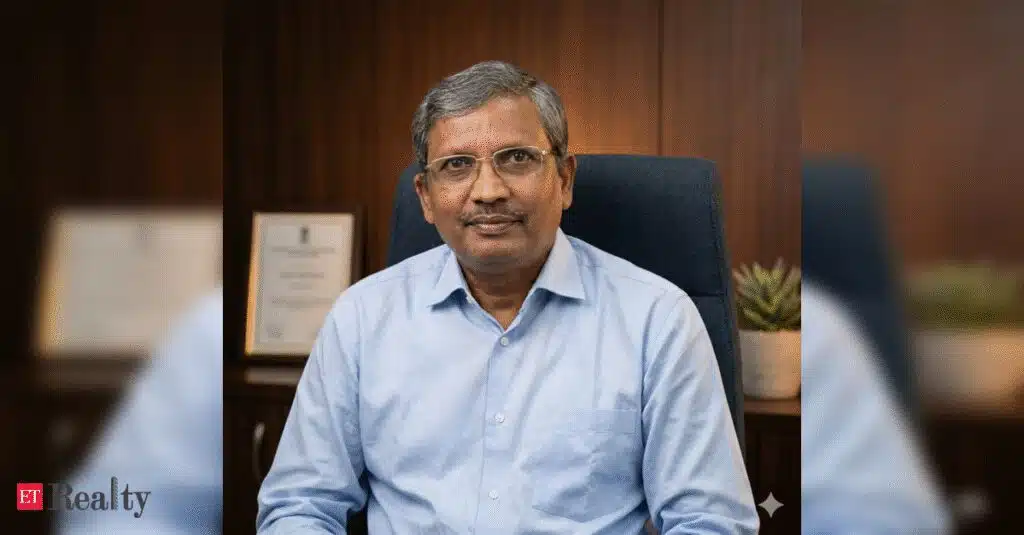
In an exclusive interaction with Ankit Sharma, Satish Chandra, chairman, J&K RERA, outlined a roadmap that includes notification of revised master plans for Jammu and Srinagar, monetisation of a 450-acre land parcel in Srinagar, mandatory registration of government agencies, and enforcement of unified building bylaws to curb unplanned plotting. Edited excerpts:
J&K RERA started relatively late compared to other states. What is the current status and what are your immediate priorities?
J&K RERA came into existence in January 2024, much later than most other states. Since then, we have been working on foundational issues to promote real estate in the Union Territory. A lot of preparatory work is required before the sector can expand in an organised manner.
One of the key areas we are working on is the revision of the master plans of Jammu and Srinagar. Both master plans are under review and require substantial changes. That exercise is almost complete and the revised plans are likely to be notified soon. Once that happens, land availability will increase and that will naturally encourage more real estate development.
Secondly, government agencies such as the Srinagar Development Authority (SDA), Jammu Development Authority (JDA) and the Housing Board hold large land parcels. They have the potential to undertake housing and mixed-use projects either on their own or through public-private partnership (PPP) models. I have been in discussion with these agencies and they are preparing to launch projects.
Another major development is in Srinagar’s Bemina area, where around 450 acres of land is available. NBCC has been tasked with preparing a comprehensive plan and monetisation strategy for this parcel. NBCC has submitted its proposal to the government and it is under consideration. If implemented, this project alone could be of the order of Rs 20,000 crore, with housing, institutional, commercial and entertainment components.
We are also focusing on correcting unplanned development practices. In J&K, there has traditionally been no concept of approved layouts. Developers often enter into agreements with landowners, subdivide land and sell plots without earmarking adequate space for roads, green areas or community infrastructure. Individual buyers then approach local bodies for building permissions, and local authorities do not always verify whether the layout conforms to planning norms.
Under unified building bylaws, a certain percentage of land must be reserved for roads, open spaces and community facilities. For example, if 15% of land is required for roads, many developers have been managing with only 6–7%, leading to narrow roads of 8–15 feet, which eventually create slum-like conditions.
We are now making it clear that plots can only be sold after RERA registration. Registration requires compliance with unified building bylaws and prior approval from local authorities. Our objective is to develop a culture of planned development where buyers receive properly laid-out plots with adequate infrastructure, and developers deliver on promised amenities such as roads, drainage, water and electricity.
If JDA, SDA or the Housing Board develop projects, will they also need to register with RERA?
Absolutely. RERA applies equally to government agencies. They cannot undertake housing projects without obtaining RERA registration.
In fact, I have advised them not only for upcoming projects but also for legacy projects that were completed years ago without occupancy certificates. I am asking them to register these projects with RERA so that pending obligations can be fulfilled and homebuyers’ grievances addressed. If there are deficiencies or incomplete infrastructure, we will ensure those are rectified.
For new projects, I have invited them to consult with us in advance. We guide them on required approvals and the process for obtaining RERA registration. The idea is to work collaboratively and ensure compliance from the outset.
As a new authority, are you adopting best practices from other states?
Yes, we are learning from states that are more advanced. For instance, when developing our website, we examined several state RERA portals and found Haryana’s to be among the best. Since it was developed by NIC, we requested NIC to replicate similar features for J&K. Our website is now live and operational within a short period.
Similarly, the three-account mechanism adopted by some advanced RERAs, where developers must maintain separate accounts for project funds, has already been implemented in J&K. We have issued a notification mandating that every developer maintain three separate accounts.
What about quarterly progress reports?
So far, only five projects have been registered, and all are legacy projects that are already complete. They have been registered primarily to address grievances of homebuyers. Therefore, the issue of quarterly progress reports does not arise in these cases.
How many projects are currently registered and what is the target going ahead?
Satish Chandra: As of now, only five projects are registered. However, several projects are in the pipeline, some by government agencies and some private ones. Four are currently under processing.
We are aiming to bring around 100 projects under RERA. Our teams are conducting site visits, identifying ongoing plotting and construction activity, and issuing notices where necessary to ensure registration.
There have been concerns in some states about recovery certificates issued by RERA not being enforced effectively. How do you see this issue?
Recovery certificates can become a challenge if there is no coordination with district administration. In J&K, we are working closely with the state government. The chief secretary has already held multiple meetings with RERA and is very proactive. I have also interacted directly with deputy commissioners.
With this level of coordination between RERA, district administration and the state government, I believe enforcement-related issues can be addressed effectively.
Are there projects in the Kashmir region that need to be registered?
Yes, there are projects in Srinagar and other parts of Kashmir that require registration. We have issued notices and are guiding developers on documentation and compliance requirements. The process is underway.
Our focus is to ensure that both Jammu and Kashmir regions move towards a more regulated, transparent and planned real estate ecosystem.