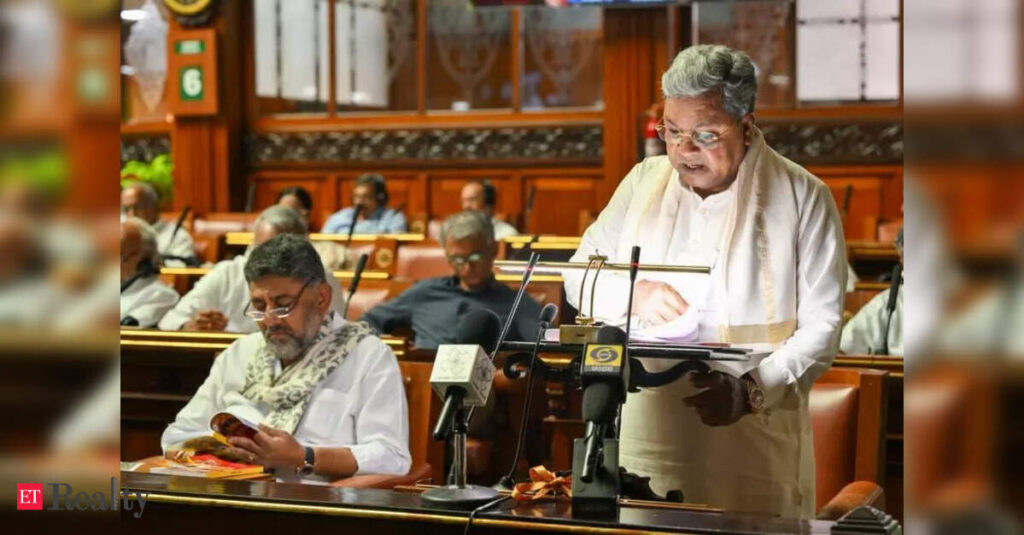
NEW DELHI: Karnataka chief minister Siddaramaiah on Friday announced a series of measures aimed at digitising land records, simplifying property registration and boosting housing and infrastructure while presenting the state Budget for 2026-27.
The government plans to integrate data from multiple land and property databases under a new Karnataka Land-Stack system that will combine information from Bhoomi, Mojini, Kaveri, e-Swathu and e-Asthi on a GIS-based digital platform.
The integrated database is expected to provide a unified digital record of land and property transactions and improve transparency in land management.
The state will also develop Kaveri 3.0, a new version of its property registration software, at a cost of ₹65 crore. The upgraded platform will enable an AI-based paperless registration process and will be integrated with asset management systems across government departments.
In urban local bodies, the government will integrate the e-Aasthi property database with a unified property tax system, which will automatically generate tax demands and arrears details.
The budget also proposes implementation of Estate Management Rules, 2026 to simplify the management of immovable properties and commercial complexes owned by urban local bodies and introduce a uniform framework for such assets.
M R Jaishankar, executive chairman, Brigade Enterprises, said the introduction of Kaveri 3.0 could help streamline property registration and reduce procedural bottlenecks.
“The much-needed introduction of Kaveri 3.0 will increase transparency and enable remote registration with integrated asset management across departments, significantly reducing procedural hurdles,” he said.
Murali Malayappan, chairman and managing director, Shriram Properties, said the move to digitise land records and registration processes could improve transparency for both developers and homebuyers.
“The Karnataka Land Stack with GIS-based mapping is a progressive move that will enhance transparency in land records and support better long-term planning for developers and investors,” he said.
Bengaluru infrastructure push
The budget outlined several ongoing infrastructure projects in Bengaluru, including ward road and infrastructure development across five city corporations at a cost of ₹1,255 crore and white-topping of 158 km of roads with an outlay of ₹1,700 crore.
Development of arterial and sub-arterial roads is being undertaken at a cost of ₹1,936 crore, while the Outer Ring Road stretch between Silk Board Junction and K.R. Puram Metro Station is being upgraded into a global-standard corridor at an estimated cost of ₹450 crore.
Stormwater drain upgrades and lake development works are also underway with an estimated investment of ₹273 crore.
The state government said grants for Bengaluru’s development, which were increased from ₹3,000 crore to ₹7,000 crore in FY26, will continue in the current financial year.
Urban local bodies under the Greater Bengaluru Authority will also be allowed to mobilise resources for development works by issuing municipal bonds.
To guide long-term urban growth, the government plans to implement the Revised Master Plan-2041 (RMP-2041) for Bengaluru by the end of 2027. A Comprehensive Mobility Plan for the city will also be prepared within six months.
Land acquisition for the 73-km Bengaluru Business Corridor Phase-1, connecting Tumakuru Road and Hosur Road, is underway, with the project targeted for completion within four years.
Housing initiatives
On the housing front, the government said 4.19 lakh houses have been completed since the current administration assumed office, with an investment of ₹7,328 crore. A target has been set to complete three lakh additional houses in the current year.
The government also announced a target of sanctioning one lakh Beneficiary-Led Construction (BLC) houses under state housing schemes.
Subsidy for beneficiaries under these schemes will be increased from ₹1.20 lakh to ₹2 lakh for the general category and from ₹2 lakh to ₹3 lakh for Scheduled Caste and Scheduled Tribe beneficiaries.
Beneficiary selection under state housing schemes will also shift from a manual lottery process to an online lottery conducted through Gram Sabhas.
Under the Pradhan Mantri Awas Yojana (Affordable Housing in Partnership) scheme, the Karnataka Slum Development Board is implementing construction of 1.29 lakh houses. The state government has allocated an additional ₹1,136 crore towards the beneficiary share, and 79,134 houses were completed during 2025-26.
Separately, the Karnataka Housing Board will distribute 50,000 residential sites under the ‘Namma Mane’ scheme at concessional rates over the next two years.