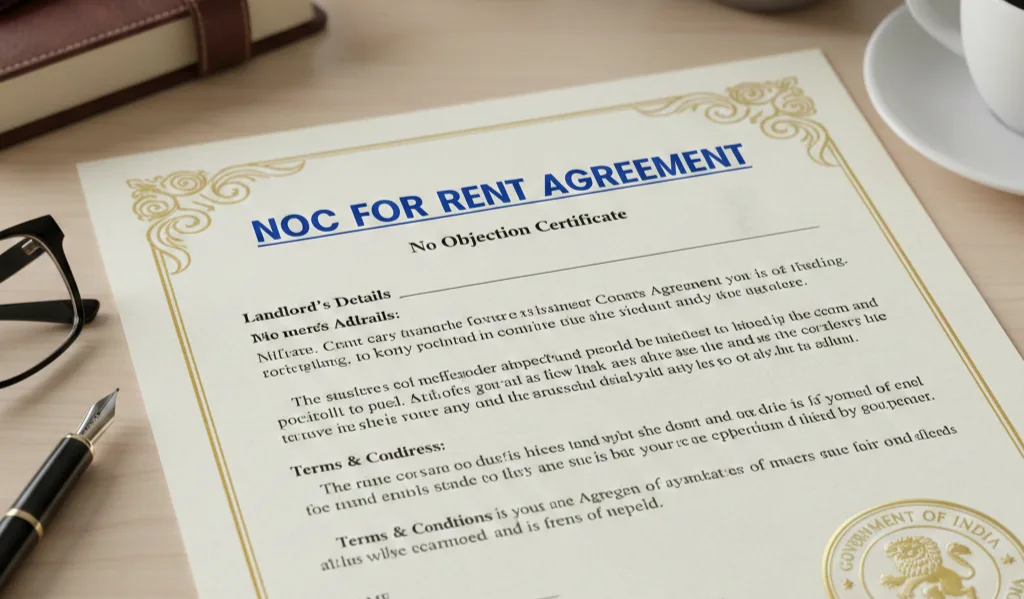
A CIDCO lease deed is a legal agreement issued by City and Industrial Development Corporation (CIDCO) that grants leasehold rights of land or property for a fixed period, typically 60 years, 90 years, or up to 99 years, depending on the allotment. It outlines ownership rights, lease terms, and usage conditions. This deed is essential for property possession, transfer, renewal, and securing loans, ensuring legal protection and clarity for CIDCO property holders.
What Is a CIDCO Lease Deed?
A CIDCO lease deed is a legally registered document that grants long-term leasehold rights to an allottee for a specific property, while the ultimate ownership remains with the City and Industrial Development Corporation. In practical terms, the CIDCO lease deed meaning involves a contract where the government allows you to use, occupy, and even build on a plot for several decades. It differs from freehold ownership because you are technically a “lessee” holding a high-security interest in the land, rather than an absolute owner of the soil itself. [1]
Nature of CIDCO Leasehold Rights
Holding a property under CIDCO involves a specific set of rights that are distinct from standard private land purchases in other parts of India. [2]
- Leasehold ownership: You own the structure built on the land, but the land itself belongs to the government.
- Right to occupy and construct: You have the legal authority to live in or develop the plot as per sanctioned plans.
- Restrictions imposed by CIDCO: Any transfer, mortgage, or major structural change requires a “No Objection Certificate” from the authority.
Tenure of a CIDCO Lease Deed
The duration of your stay and the conditions for staying longer are clearly defined in the cidco lease agreement to ensure long-term stability. [3]
Unbeatable Price 5-Star Rated Partner! 2200+ Shades! Top Quality Paint Free Cancellation!
Get a rental agreement with doorstep delivery
Find the BEST deals and get unbelievable DISCOUNTS directly from builders!

5-Star rated painters, premium paints and services at the BEST PRICES!
- Typical lease period: Most allotments are granted for a period of 60 years, though some special cases extend to 99 years.
- Renewal conditions: Standard policies typically allow lease extensions upon payment of a renewal premium to the authority.
- Ground rent obligations: Allottees must pay a nominal annual ground rent to keep the lease active and legally valid.
Types of CIDCO Lease Deeds
CIDCO issues different formats of deeds depending on the intended use of the property and the specific allotment scheme. [4]
- Residential Plot Lease Deed: Issued for individual homes or housing society lands where families reside.
- Commercial Plot Lease Deed: Used for shops, office complexes, and retail spaces in planned business districts.
- Industrial Plot Lease Deed: Specifically for manufacturing units or IT parks with clauses focused on employment and production.
- CIDCO Flat / Building Lease Deed: Executed for constructed tenements in mass housing schemes or cooperative societies.
When Is a CIDCO Lease Deed Issued?
The issuance of a cidco lease deed marks the final stage of the property acquisition process after all preliminary conditions are met. [5]
- After plot or flat allotment: Once the lottery or tender process is complete and you are selected.
- Upon completion of payment: All premiums, service charges, and interest must be cleared in full.
- Before construction or transfer: It is often required to prove legal standing before starting work or selling.
- During conversion stage: When a temporary “Agreement to Lease” is upgraded to a formal, registered lease deed.
Key Features of a CIDCO Lease Deed
Understanding the core components of the CIDCO lease deed format helps allottees manage their property without facing legal hurdles or cancellations. [6]
- Long-term lease tenure: Provides decades of security, ensuring you can pass the rights to your legal heirs.
- CIDCO retains ownership: The authority keeps the title, which helps prevent unauthorized land-use changes.
- Possession and usage rights: You receive exclusive rights to enjoy the property without interference.
- Transfer subject to approval: Selling the rights requires an NOC and the payment of specific transfer charges.
- Development regulations: Every construction must strictly follow the building bylaws set by the CIDCO town planning department.
- Breach consequences: Violating the terms, such as non-construction, may result in cancellation of the allotment.
Rights and Responsibilities of the Allottee
Being a CIDCO lessee involves a balance of legal protections and administrative duties that must be fulfilled regularly. [7]
Rights
- Right to occupy and develop: You have the authority to use the property and construct according to sanctioned maps.
- Ability to transfer or mortgage: You can sell your leasehold rights or take a home loan after obtaining an NOC.
Responsibilities
- Timely payment: You must clear the lease premium and annual ground rent to avoid heavy interest penalties.
- Compliance with norms: Every structure must adhere to construction limits and Floor Space Index (FSI) rules.
- Adherence to conditions: You must use the land only for the purpose mentioned in the deed (e.g., residential).
Documents Required for CIDCO Lease Deed
To execute and register a cidco lease deed, you must gather a comprehensive set of identity and allotment proofs. [8]
- CIDCO allotment letter: The original document proving you were granted the specific plot or flat.
- Identity and address proof: Valid Aadhaar cards, PAN cards, and current address documentation for all signatories.
- Property/site plan documents: Sanctioned maps showing the boundaries and location of the unit.
- Payment receipts: Evidence that all premiums and service charges have been paid to the CIDCO treasury.
- Draft CIDCO lease deed: The prepared legal document on appropriate stamp paper for registration.
- Photographs of allottee: Required for the biometric records at the Sub-Registrar’s office.
- Stamp duty receipts: Proof of payment for the mandatory government registration taxes.
How to Make a CIDCO Lease Deed?
Learning how to make cidco lease deed involves a structured legal path that requires coordination between the authority and the registrar.
Receive allotment letter from CIDCO
The process begins when you receive your formal offer. You must complete all payment obligations and verify the property details listed in the letter.
Prepare draft CIDCO lease deed
Once financial dues are cleared, you must prepare the deed draft. It is helpful to refer to the lease deed standards to ensure all legal clauses are present.
Execute and register the deed
Visit the local Sub-Registrar’s office to sign the document in the presence of witnesses. You must follow the steps to register the lease deed to ensure it is legally binding.
CIDCO Lease Deed vs CIDCO Lease Agreement
While they may sound similar, these two documents represent different stages of your legal relationship with the authority. [9]
| Feature | CIDCO Lease Agreement | CIDCO Lease Deed |
|---|---|---|
| Nature of Document | A “license” to enter the land and build. | A final “demise” formalizing long-term rights. |
| Legal Status | Intermediate contract before compliance. | Definitive title document for leasehold rights. |
| Registration Requirement | May be registered, but has limited weight. | Mandatory registration for full legal validity. |
| Stage of Allotment | Issued early, after initial payments. | Issued after construction and final compliance. |
| Transfer of Rights | Difficult to transfer or mortgage. | Fully mortgageable and transferable with NOC. |
| Purpose | Focuses on construction timelines. | Focuses on long-term possession and use. |
How NoBroker Can Help With CIDCO Lease Deeds?
Navigating the paperwork for what is a lease agreement with CIDCO can be overwhelming due to strict administrative rules. NoBroker assists allottees by providing expert support for CIDCO lease deed drafting and verification. Our platform offers standard templates that comply with the latest authority guidelines. We help you coordinate documentation, calculate stamp duty, and manage registration coordination at the Sub-Registrar’s office. NoBroker ensures your entire process is smoother, more accurate, and completely brokerage-free, allowing you to secure your property rights with no hassle.
Frequently Asked Questions
Ans: It is a formal legal document that grants an individual the right to use and occupy land owned by CIDCO for a long-term period, usually 60 or 99 years.
Ans: No, it is a leasehold property where CIDCO remains the owner of the land. However, as of July 2025, residential plot owners can apply to convert their status to freehold for a fee.
Ans: Yes, it can be sold or transferred to another person, but this requires a No Objection Certificate (NOC) from CIDCO and the payment of mandatory transfer charges.
Ans: Yes, for the lease to be legally valid and recognized by banks or courts, it must be registered with the local Sub-Registrar and involve the payment of stamp duty.
Ans: A typical CIDCO lease is valid for 60 years. It can usually be renewed for another 99 years or, under new policies, converted into perpetual freehold ownership.
Loved what you read? Share it with others!
ARTICLE SOURCES
- https://allisonyogi.com/blog_detail.html?id=22#:~:text=CIDCO%20is%20the%20planning%20and,buildings%2C%20or%20larger%20development%20projects.
- https://tigdelawfirm.com/leasehold-property-rights-in-maharashtra/
- https://santoshproperty.in/what-is-cidco-allotment-and-how-does-it-work/
- https://www.ashoknandavanam.com/blog/lease-deed-meaning-format-example-and-types
- https://www.scribd.com/document/102481168/12-5-Gaothan-Scheme-of-CIDCO
- https://iovrvfhub.org/media/e_journals/55789_suresh_kumar-2-4.pdf
- http://utkarsh.cidcoindia.com:7083/sap(bD1lbiZjPTkwMA==)/bc/bsp/sap/zcrm_bot_portal/index.htm
- https://www.dearsociety.in/post/2022/01/24/the-ultimate-guide-to-deemed-conveyance-cidco/
- https://www.casemine.com/search/in/Cidco%2Clease%2Bdeed
 Author
Source link