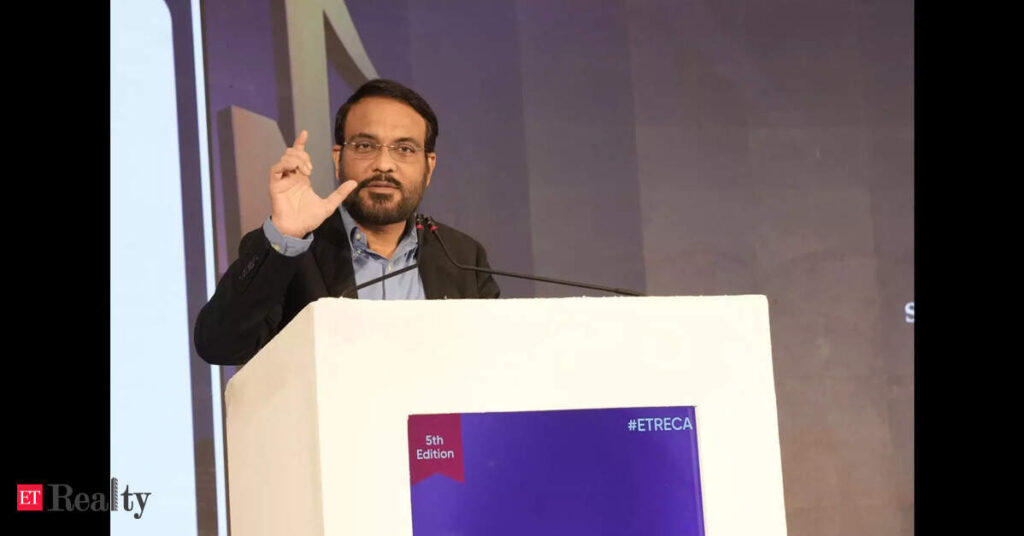
NEW DELHI: Mumbai’s redevelopment strategy is increasingly shifting from individual building projects to large-scale cluster redevelopment, according to Sanjeev Jaiswal, vice president and chief executive officer of the Maharashtra Housing and Area Development Authority (MHADA).
In an exclusive interview with Ankit Sharma, Jaiswal said MHADA is prioritising redevelopment of large housing layouts across the city, which could unlock 800-1,000 acres of land for redevelopment and generate a significant supply of affordable housing units over the coming years.
He also highlighted the authority’s focus on expanding affordable housing for economically weaker sections (EWS) and lower income groups (LIG), accelerating redevelopment of ageing housing stock, and addressing the high cost of housing in Mumbai through policy reforms. Edited excerpts:
What are MHADA’s key priorities for the next few years?
The primary objective is to increase the supply of affordable housing, especially for the economically weaker sections and lower income groups, and to some extent the middle-income segment. MHADA houses are generally priced lower than those developed by private developers.
Another priority is redevelopment. As part of the Mumbai Metropolitan Region growth hub identified by NITI Aayog, MHADA has taken up the challenge of facilitating the construction of around 8 million houses, either directly or indirectly, through redevelopment projects under regulations such as DCPR 33(5), 33(7) and 33(9).
The third focus area is reducing housing costs. Mumbai’s affordability index remains very high, and policy interventions are required to make housing more affordable.
How do you see the role of redevelopment in Mumbai’s housing market?
Historically, redevelopment in Mumbai was largely limited to individual buildings or small clusters of two or three buildings.
Over the last couple of years, there has been a clear shift toward cluster redevelopment, where larger land parcels are redeveloped as integrated projects. MHADA currently has 114 layouts in the suburbs, and the focus now is on redeveloping larger clusters instead of approving individual building proposals.
Several projects are already underway or in the pipeline, including Motilal Nagar, SVP Nagar, GTB Nagar in Sion, Abhyudaya Nagar, Kamathipura, Magathane, Mandvi Reclamation, Adarsh Nagar and Aram Nagar.
Overall, cluster projects covering around 800 to 1,000 acres in Mumbai are at various stages of approval, tendering or implementation.
Will cluster redevelopment significantly increase affordable housing supply?
Yes. In cluster redevelopment, the first priority is rehabilitation of existing residents, who are currently living in smaller homes.
For example, residents occupying homes of 160–200 sq ft may receive units of around 550-650 sq ft, which significantly improves living conditions.
In addition, MHADA expects to receive around 10 lakh sq metres of housing stock from cluster projects over the next six to seven years, which translates to roughly 20,000 units. These homes will largely fall in the 500-700 sq ft affordable housing segment.
MHADA sells such houses based on a formula linked to the ready reckoner rate rather than market prices.
What is the status of redevelopment projects such as Kamathipura and BDD Chawl?
Kamathipura redevelopment was a complex project due to the large number of stakeholders. There are around 800 landowners and about 7,500 tenants, and building consensus took significant time.
The redevelopment proposal has been approved by the cabinet, and a developer has been selected for the project, with final government approval awaited.
The BDD Chawl redevelopment is one of the largest housing projects being implemented by MHADA. In Worli alone, about 17,000 rehabilitation units are being developed.
The project involves around 15 lakh sq metres of FSI, including commercial components. Funding models are still being evaluated, including possible monetisation of commercial space.
What are the major challenges in redevelopment projects?
One of the biggest challenges relates to the cost of housing. Affordable housing requires coordinated action from multiple stakeholders including state agencies, municipal bodies and the central government.
Policy measures such as reducing premiums, development charges, cess, GST and stamp duty for affordable housing could significantly lower project costs. If such measures are implemented, housing prices in the affordable segment could potentially fall by around 25%.
Another challenge arises in redevelopment projects where developers compete by offering larger rehabilitation units than those permitted under regulations, which can lead to disputes and project delays.
How important is infrastructure planning in redevelopment projects?
Infrastructure planning becomes more efficient when redevelopment happens at a larger scale.
In individual building redevelopment, infrastructure costs tend to be higher per unit. However, when redevelopment takes place across 20–30 acre clusters, the cost of infrastructure is distributed across more units, reducing the burden on individual homeowners.
This is one reason why MHADA is encouraging cluster or mini-cluster redevelopment models.
What is the current situation regarding cess buildings in Mumbai?
Earlier, Mumbai had around 19,000 cess buildings, which has now reduced to about 13,000. Some of the reduction is due to redevelopment, while others were demolished due to structural deterioration.
A recent amendment allowed tenants to initiate redevelopment proposals if landowners failed to act within six months after a building was declared dilapidated. However, legal challenges have temporarily halted the implementation of this provision.
MHADA is also working on an exit policy for cess buildings, with the long-term objective of redeveloping most such buildings over the next 10–15 years, except those that remain structurally sound.
What is the progress under PMAY and rental housing initiatives in Maharashtra?
Under PMAY Urban 1.0, around 9.5 to 10 lakh houses were planned across different components, including affordable housing projects, beneficiary-led construction and credit-linked subsidy schemes.
One of the largest PMAY projects in the country is Raynagar in Solapur, where around 30,000 houses are being developed.
Under PMAY 2.0, beneficiaries must register online before projects can be approved. Around 1-1.25 lakh houses across various components have already been approved.
Separately, Maharashtra’s new housing policy introduced in 2025 includes rental housing for the first time. MHADA, as the nodal agency, has prepared draft rules and is currently consulting stakeholders.
The policy also includes new housing categories such as working women’s hostels, student housing, industrial worker housing and old-age homes.
How has MHADA performed financially in recent years?
MHADA recorded around 38% growth in revenue collection last year.
The authority is also seeing strong financial improvement. When I took charge, MHADA had fixed deposits of around ₹150 crore. Today, the figure has increased to roughly ₹5,000 crore.
Cluster redevelopment projects alone could generate around ₹25,000 crore in premiums over the next five to seven years, while also creating significant affordable housing stock.
MHADA is also exploring whether it can take up housing projects outside Maharashtra through national-level bidding processes.